Rites before Baptism
Understanding is not required for Baptism but preparation is. In fact, true understanding is the result and fruit of Baptism rather than its condition. This is why, in the early church, catechumens were not taught about the sacraments or even learned the Lord’s Prayer until after Baptism. Their preparation lasted from one to three years when they were progressively introduced into the life of the Church by special rites which included exorcisms, prayers, fasting and the intensive study of Holy Scripture. This preparation was an act of the entire Church, not just the individuals being baptized, and developed into the Paschal liturgical season which is now known to us as Great Lent.
Prayers after childbirth and the naming
The prayers said immediately after childbirth primarily concern the mother, for her healing and recovery, as well as for the forgiveness of sins. On the eighth day after birth we have the naming of the child. These prayers primarily concern the child and are essentially the same as the “Prayers at the Reception of Catechumens.” They serve to prepare the child for entrance into the life of the Church. That is why they take place on the eighth day, because the eighth day is symbolic of eternity in the Kingdom of God. The Church takes possession of each child in the name of Christ. By this the Church reveals each name as holy and sanctified by the name of Christ. Each person is a child of God destined for personal relationship with Him. The child’s name itself is sanctified and holy. This understanding of the name as holy gave rise to the tradition of taking the name of a patron saint. Each Christian name made holy by the earthly life of the saint is kept and preserved in the life of a new person dedicated to Christ. In this way the name is sanctified again and again. This is one manifestation of the experience of the Church as a communion of saints.
The churching of the mother and child
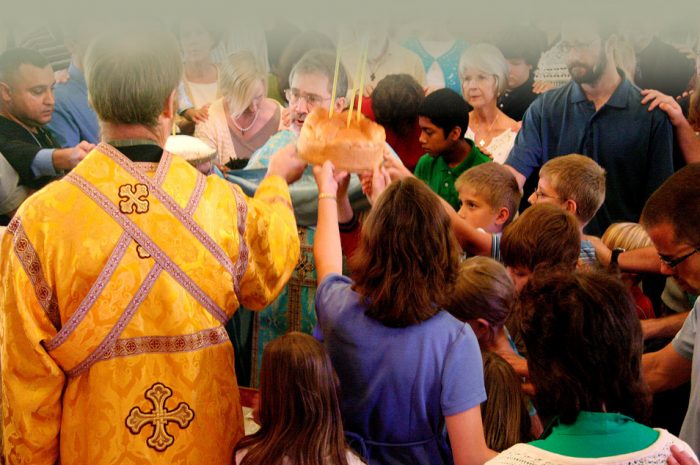
On the fortieth day after birth the parents bring the child to the Church. This is the rite of the mother’s return and the presentation of the newborn to the Church. After recovering from child-bearing the mother returns to full participation in the sacramental life of the Church. The parents also present their newly born but non-baptized child to the Church. The Christian family therefore becomes an organic unit within the family of God. In the Church the Christian family receives the source, the content, and the transcendent goal of its existence as family. Therefore the child that belongs to his or her parents in a biological sense now belongs to the Church in a spiritual sense.
|
On Infant Baptism
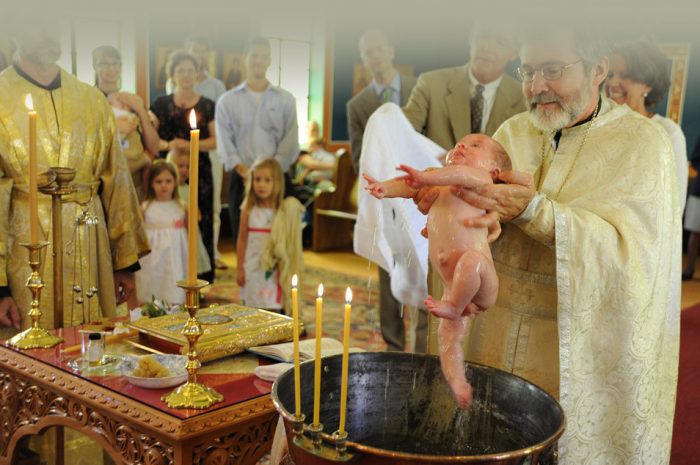
There are some who object to infant Baptism on the grounds that a true Christian must make a personal confession of faith. And since an infant is unable to speak and unable to understand as we would assume is required to profess the faith, they should not receive baptism. To this objection we would ask, “To whom is it given the ability to measure faith, to pass judgment on the degree of comprehension and desire in it?” By this measure adult baptism is no more valid than infant baptism. Christianity is a confession of faith, “Jesus is the Son of God, He is Lord and King.” But this confession is more than just words spoken. It is a life that is lived in Christ so that we may recognize Him in all things. Therefore just as an infant is able to recognize and love its mother or father or anyone who cares for and loves the child, so too an infant that is raised in the Church, who lives in the context of a Christian family, is able to recognize and love Christ. This is a true confession of faith.
In Baptism we receive the faith and life of Christ as revealed in the Church. This is why the Church does not randomly baptize any child off the street but only those whose parents and sponsors present the child for Baptism from within the community of faith and make a pledge to raise the child in the faith. This sacrament is the beginning of faith and God’s response to it. This sacrament makes faith possible. Each time we witness a baptism we are witnesses of divine mercy and forgiveness. We witness the re-creation of the world and of one more person in it. We all become responsible for the upbringing of that child in the Christian faith. All of this is reflected in the rite of churching, which applies precisely to non-baptized children of Christian parents who present their child to the Church for Baptism.
In scripture it is very clear that when the gospel was preached, and all heard, and all believed, they all received the Spirit, and they were all baptized, the entire household. Cornelius’ household -Acts 10. Lydia’s household – Acts 16:15. The jailer’s household – Acts 16:33. Crispus’ household - Acts18:8. Stephanas’ household – I Cor. 1:16. It simply does not make sense for a Christian household to have un-baptized members. Where the gospel is preached and accepted, all are baptized. In this way the entire household becomes united in the body of Christ. |